

A student remembers to bring home the correct homework folder. Another independently transitions from recess back to class. A third raises their hand before speaking instead of interrupting.
These moments may seem small, but they all rely on one essential set of skills: executive functioning.
Executive functioning allows students to organize, plan, adapt, regulate emotions, manage time, and complete everyday school tasks. These skills influence academic achievement, classroom behavior, social participation, and independence.
When executive functioning challenges create barriers to learning, school-based occupational therapists (OTs), physical therapists (PTs), and speech-language pathologists (SLPs) collaborate with educators to develop practical, evidence-based supports that help students participate more successfully throughout the school day.
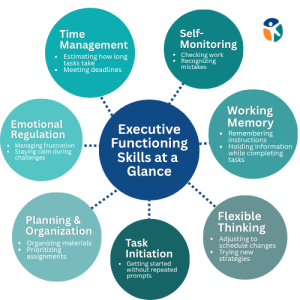
Executive functioning is often described as the brain’s “management system.” Rather than representing a single skill, executive functioning includes a collection of mental processes that help students regulate their thoughts and actions while working toward a goal.
These skills can include:
Students rely on these abilities every day whether they’re completing a writing assignment, following classroom routines, managing materials, or collaborating with peers.
The American Speech-Language-Hearing Association (ASHA) notes that executive functioning supports learning, communication, problem-solving, and successful participation in everyday activities. Difficulties may affect a student’s academic performance, social interactions, and independence in school. (Source: ASHA Practice Portal: Executive Function Deficits)
School-based therapists help students build the skills they need to participate successfully throughout the school day. Executive functioning challenges might make it difficult for a student to:
Because these challenges affect educational participation, executive functioning often becomes part of a collaborative intervention plan.
School-based occupational therapists help students develop routines and strategies that make classroom participation more successful.
Depending on the student’s needs, occupational therapy interventions may include:
Rather than completing work for students, OTs help students build the skills needed to become increasingly independent.
The American Occupational Therapy Association (AOTA) emphasizes that school-based occupational therapy promotes participation in educational activities through occupation-based, evidence-informed interventions that are meaningful within the student’s daily routines.
Executive functioning and communication are closely connected.
School-based speech-language pathologists often address executive functioning while supporting students with:
According to ASHA, evidence-supported intervention includes explicit strategy instruction, metacognitive approaches, environmental supports, and collaboration with educators to help students apply executive functioning skills across school settings.
Executive functioning also influences movement throughout the school day.
School-based physical therapists help students participate safely and independently by addressing mobility challenges that can increase cognitive demands.
Physical therapists may support students by improving their ability to:
Although PT interventions focus primarily on functional mobility, collaboration with educators and related service providers ensures that movement supports align with the student’s educational goals.
Research consistently shows that students benefit when executive functioning supports are integrated into meaningful daily routines instead of isolated activities.
Examples include:
External Supports
Environmental Supports
Metacognitive Strategies
Students are encouraged to ask themselves:
ASHA identifies metacognitive instruction, strategy-based learning, and environmental modifications as evidence-supported approaches for improving executive functioning in children and adolescents.
Executive functioning isn’t taught during one therapy session each week. Students make the greatest progress when the same strategies are reinforced throughout their day. That is why collaboration is central to school-based therapy! Collaboration is key among teachers, OTs, PTs, SLPs, school psychologists, special education staff, families, and school administrators.
Together, these professionals create consistent supports that help students develop lasting habits across classrooms, lunchrooms, playgrounds, and school routines.
Joint Statement on Interprofessional Collaborative Goals in School-Based Practice
Executive functioning continues to receive increased attention as schools focus on preparing students not only for academic success, but also for lifelong independence.
Strong executive functioning supports help students become, independent learners, effective communicators, flexible problem-solvers, and confident participants in school and community life.
As educational teams continue embracing collaborative, student-centered approaches, occupational therapists, physical therapists, and speech-language pathologists will remain essential partners in helping students develop these critical life skills.
Helping students strengthen executive functioning isn’t about finding one perfect strategy, it’s about creating supportive environments where students can practice, adapt, and succeed.
At AOT, Inc., we partner with school districts throughout Western Pennsylvania to provide collaborative, evidence-informed occupational therapy, physical therapy, and speech-language pathology services that support student participation and educational success. By working alongside educators and families, our clinicians help students develop the skills they need to navigate the classroom with greater confidence, independence, and resilience.
Whether it’s organizing materials, managing transitions, communicating effectively, or solving everyday challenges, executive functioning skills lay the foundation for lifelong learning and we’re proud to help students build that foundation every day!